
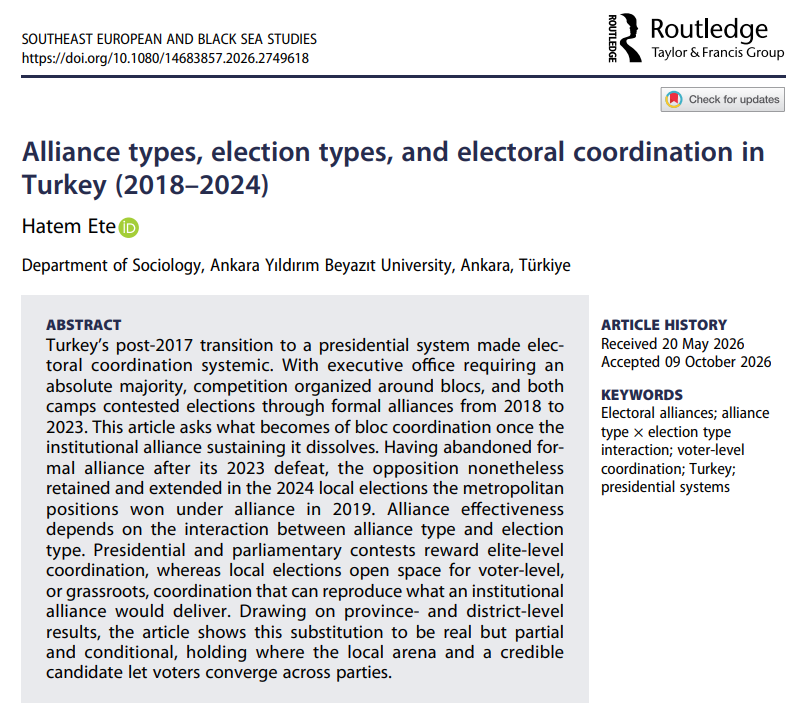
The article entitled “Alliance Types, Election Types, and Electoral Coordination in Turkey (2018–2024),” authored by our faculty member Assoc. Prof. Dr. Hatem Ete, has been published in the international peer-reviewed journal Southeast European and Black Sea Studies (Routledge / Taylor & Francis).
The study examines the conditions under which electoral alliances succeed in Turkey following its 2017 transition to a presidential system. The article argues that an alliance’s effectiveness depends on the interaction between alliance type and election type: presidential and parliamentary elections reward elite-level institutional coordination, whereas local elections open space for voter-level (“grassroots”) coordination. This framework explains how the opposition lost the 2023 general elections with the broadest institutional alliance in its history yet won the 2024 local elections without one.
Drawing on province- and district-level official election results, the article shows that the metropolitan outcome an institutional alliance produced in 2019 was reproduced in 2024 through voter-level coordination in the absence of an alliance, and that this substitution is real but partial and conditional, emerging in local arenas where a credible candidate anchors it.
The article is available at: https://www.tandfonline.com/doi/full/10.1080/14683857.2026.2749618