
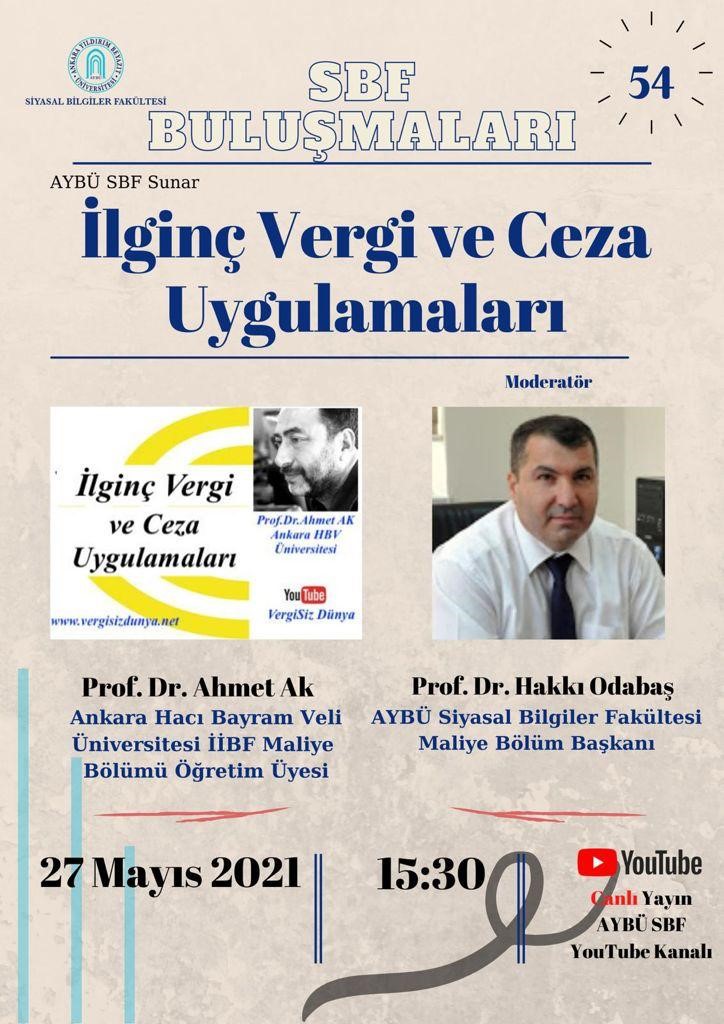
54th SBF Meetings: Interesting Tax and Penalty Practices
The 54th of the traditional meetings organized by our faculty was held on 27.05.2021 through digital platforms with the title of "Interesting Tax and Penalty Practices".
Our program was organized by Ankara Yıldırım Beyazıt University Faculty of Political Sciences. The meeting started with the opening speech of Prof. Dr. Hakkı Odabaş, Head of Department of Public Finance.
Prof. Dr. Ahmet Ak, as the invited speaker of the meeting, first started his speech by stating that the taxation and punishment authority in the Turkish tax system is among the inalienable duties and powers of the state. In this context, he stated that when the constitutional basis of taxation is considered, Magna Carta dated 1215 comes to mind, but in the Turkish-Islamic past, during the Karakhanid State period, in the Kutadgu Bilig, the fact of paying the tax on time in terms of the rights of the khan over the people, and the fact of paying taxes only on the real income, not on the fictitious income in terms of the rights of the people over the khan, took place. Prof. Dr. Ak, then, emphasized that the laws in Turkish tax law should have internal integrity as well as being compatible with each other, and said that interesting tax and penalty practices emerged within this framework. Stating that one of the interesting tax applications is the tax of tax, Prof. Dr. Ak gave the collection of VAT over SCT as an example. Prof. Dr. Ak cited the collection of stamp duty when calculating income tax on wages, collection of taxes within the scope of non-operating income in terms of the support paid, such as grants to tradesmen during the pandemic period, within the scope of social transfers as examples of interesting tax practices. Another examples are VAT payment on the price of expropriaton price in case the expropriated property is returned to the owner, while VAT is not calculated on the price when expropriation is made and environmental taxes which is not in accordance with the principle of decentralization in terms of tax technique. Within the scope of interesting practices regarding penalties, Prof. Dr. Ak mentioned that the penalty provisions are not be touched while restructuring taxes and that such laws should be enacted by qualified majority in the Parliament as they weaken the awareness of paying taxes. As another interesting practice, he stated that although those who print fake documents and those who knowingly use them are included in the scope of tax evasion in accordance with Article 359 of the Tax Procedure Law, the main perpetrators who request printing these documents are not punished. Apart from this, Prof. Dr. Ak mentioned that high fines are imposed by the private sector without notification when passing through private highways and that the penalty does not comply with the correction function, and that attorney's fees and VAT are collected over these fines. Prof. Dr. Ak also focused on the question of whether the state that imposes penalties is successful, and underlined that the state's imposition of too many penalties shows that sociological factors are not taken into account while making rules, rather than being successful, and that people who will abide by the rules are not convinced. Finally, Prof. Dr. Ak stated that it was concluded that analysis should be made in terms of compatibility with sociological realities while setting rules in tax law.