
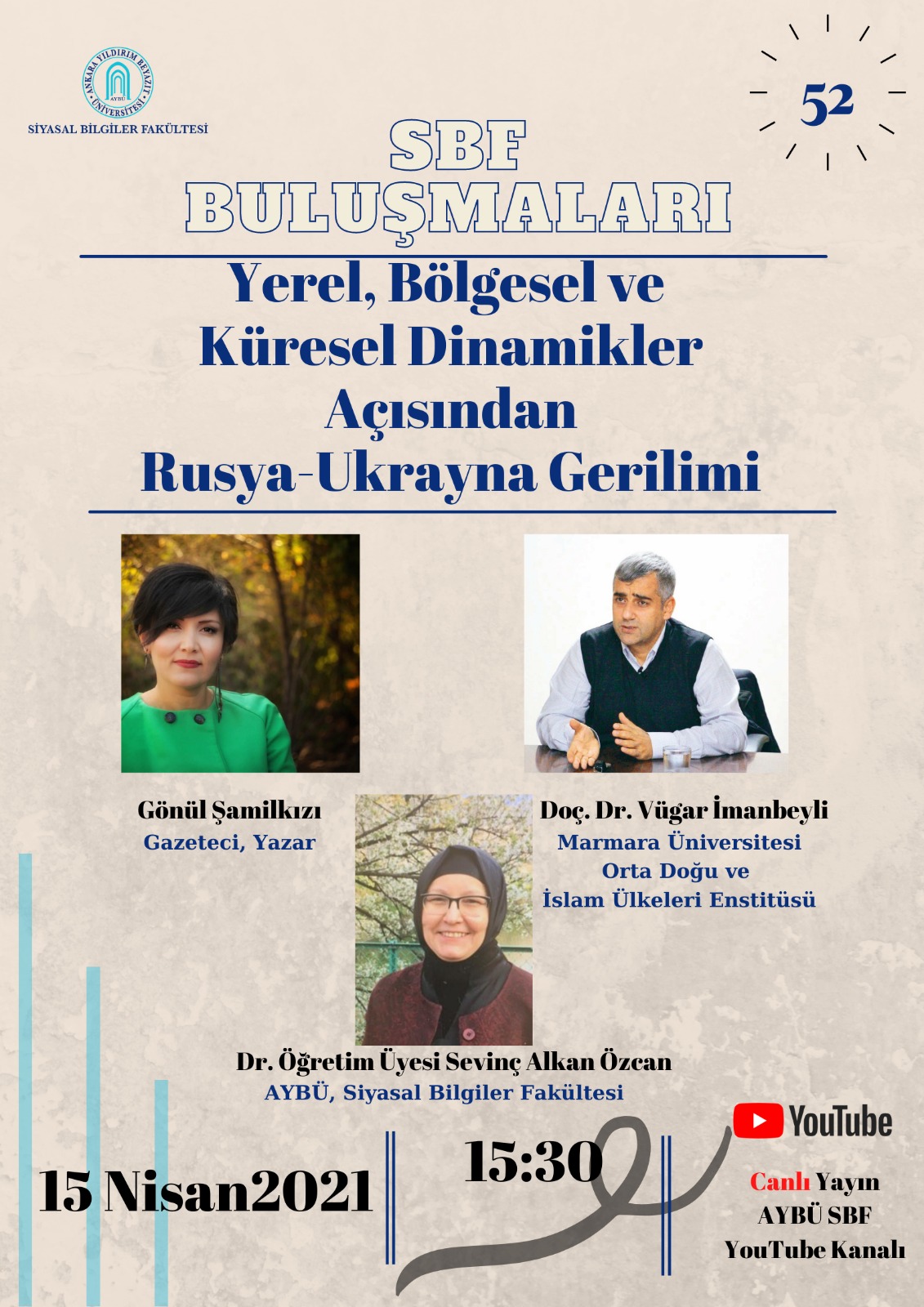
52nd SBF Meeting
52nd of the traditional SBF meetings of our faculty, moderated by Dr. Sevinç Alkan Özcan, was held with the participation of Assoc. prof. Vügar Imanbeyli and Gönül Samilkızı on the topic of Russia-Ukraine tension in terms of local, regional and global dynamics. Our event was conducted through digital platforms due to pandemic conditions.
The program begin with the presentation of Assoc. Prof. Vügar Imanbeyli. Imanbeyli has focused on why the tension has turned into a crisis at the moment today, the timing of the crisis and the local and regional dynamics of the crisis. In Ukraine, Zelensky's capture of power with 73% of the vote with three-month political experience shows that there is no tolerance for existing politicians in Ukraine. Having seized power with populist promises, Zelensky today took a hawkish approach and resorted to nationalist policies in order to maintain his current position, while promising to end the war during the election period. In this context, Assoc. Prof. Imanbeyli mentions three possible scenarios. The first is a scenario that will prepare for a global conflict, which is a very remote possibility. The second is to limit the crisis to particular area with local conflicts. The third is the continuation of the ceasefire and the current status quo.
Dr. Sevinç Alkan Özcan, on the other hand, points out that there is a polarization that should be considered in Ukrainian society. In political elections, this polarization clearly manifest itself. The polarization between pro-Russian and nationalist and pro-Western also brings different approaches to the current crisis in Ukraine. Therefore, although the crises that occur today come to the fore, since the independence of Ukraine in the 1990s, we have witnessed tensions between the two countries, where local dynamics are the main factor. The latest tension is also related to the tension between the churches experienced in 2018-2019.
Gönül Samilkızı started his speech by drawing attention to the military actions carried out by Russia in the region under the pretext of protecting its citizens. Samilkizi emphasizes that Russia has settled in a region under a military base or peacekeeping force and gived passports to the people living the area, and then in the past Georgia has laid the legitimate ground for its military actions, as in Ukraine today, so this risk should be evaluated in Nagorno-Karabakh rather than focusing on the Nagorno-Karabakh victory. Zelenski, on the other hand, experienced a very rapid rise, as well as a very rapid decline. He failed to keep promise given during election period. Because it is not easy to manage the elite in Ukraine, the current system and Russia's expectations at the same time. Therefore, in order to camouflage this decline, Zelensky had no choice from adopting a more nationalist rhetoric, considering the conflicts in the region. Russia is trying to keep Ukraine away from Crimea and the Donbas with all its means.