
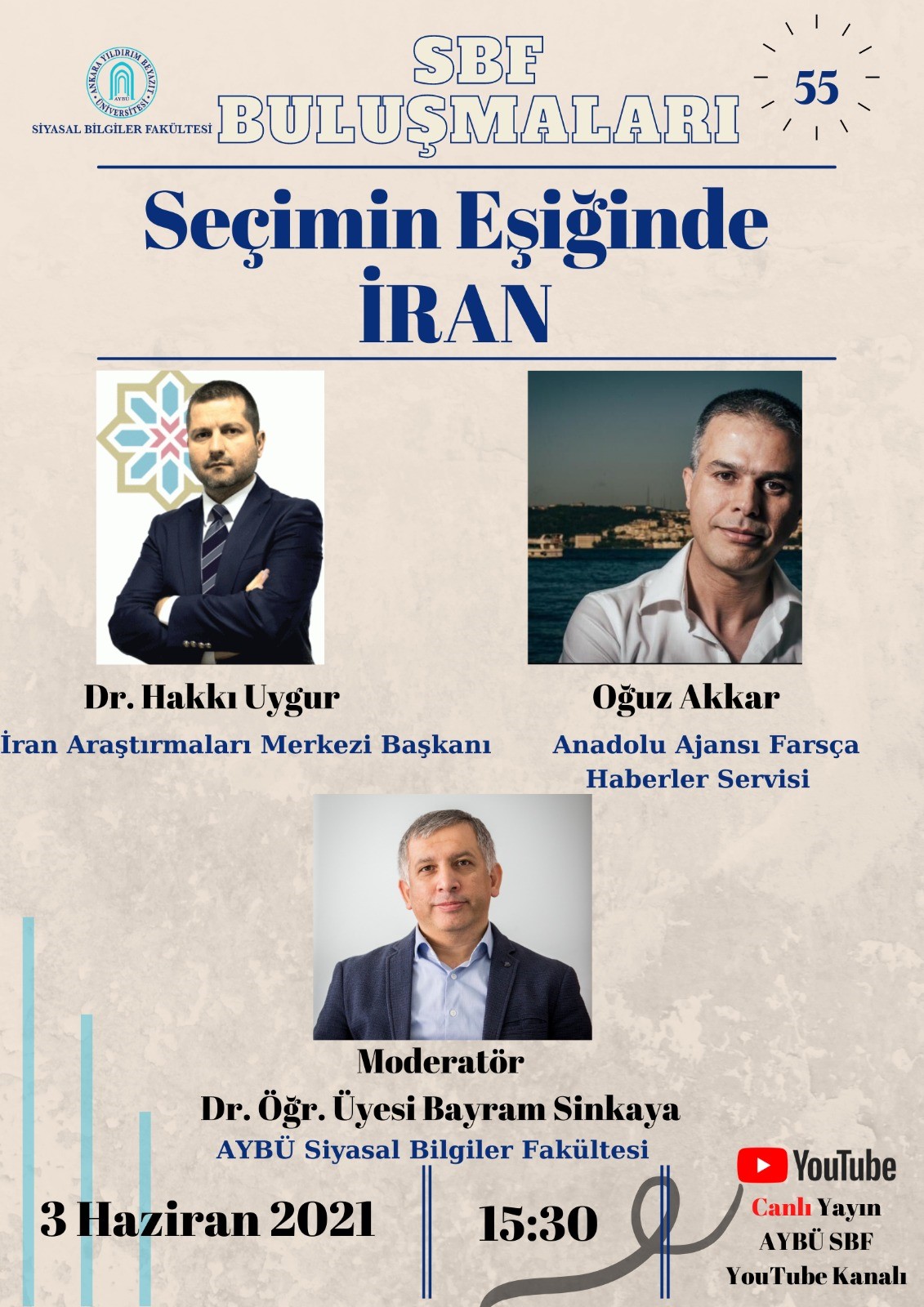
55th SBF Meeting
55th of the traditional SBF meetings of our faculty, moderated by Dr. Sevinç Alkan Özcan, was held with the participation of Oğuz Akkar from Anadolu Agency and Hakkı Uygur from IRAM on the topic of presidential election in Iran. Our event was conducted through digital platforms due to pandemic conditions.
The program begins with the presentation of Oğuz Akkar. In the Constitution of Iran, the legislative, executive and judicial bodies are dependent on the ‘Great Leader of the revolution ' as stated in the Constitution of Iran. The purpose of using this phrase is the belief that revolution is an ongoing process, not a done one. The religious leader is seen as the ultimate authority. The Guardian Council of the Constitution, controlled by the religious leader, plays an important role as the authority that approves the candidacy of presidents. The Chief of police of Iran, the head of the Supreme Court, half of the members of the Guardian Council of the Constitution are appointed by the religious leader. The other half of this council is appointed by the president of the Supreme Court, who is appointed by the religious leader. A significant amount of the resources of the Iranian economy are also operated through foundations linked to the religious leader. Oil and natural gas trade are also carried out through these foundations. The supreme court does not have a supervisory authority over these foundations, and the president cannot interfere in the functioning of these foundations. Another important point mentioned by Oguz Akkar is that even if the president forms a cabinet, he can appoint four strategic ministries, such as the Ministry of Interior, Defense, Foreign Affairs and Justice, with the approval of the religious leader. In short, the president, who was directly elected by the people, was deprive of important powers in Iran and crucial authorities are transferred to the control of the regime.
Hakkı Uygur stated that the regime was preparing Ibrahim Reisi for the presidency and then for the religious leadership in order not to face a surprise like Khatemi. It seems that the conservative base is also uncomfortable with Reisi, who is very inexperienced politically. The fact that the same names are constantly changing positions bothers this base. As Cevat Zarif notes in his audio recording, foreign policy and the economy are not under the control of the government. In this closed political system, the government cannot play a role. The regime also prevents figures who have the potential to challenge them from entering the election. It is obvious that the voter turnout will also be very low. At this point, relations with the United States do not look likely to progress. It is foreseen that relations are conducted without increasing tensions but without reaching an agreement as agreed on by both sides.