



Dr. Çağatay Balcı’nın “The Future of Ethno-Sectarian Extremism in Iran: Characteristics of the Post-Jundallah Era” başlıklı analizi ULİSA-TAIPS tarafından yayımlandı.
Analize buradan ulaşabilirsiniz.
The analysis written by Çağatay Balcı, Ph.D. has been published by ULISA-TAIPS: “The Future of Ethno-Sectarian Extremism in Iran: Characteristics of the Post-Jundallah Era”
The analysis is available here.

The Future of Ethno-Sectarian Extremism in Iran: Characteristics of the Post-Jundallah Era Ethno-Sectarian Extremism in Iran
Çağatay BALCI*
* PhD, Indipendent Researcher, cgtyblc@gmail.com
This situation has been observed in the Sistan-Baluchistan region, in Iran. The Sistan-Baluchistan region in Iran is currently one of the provinces of the Islamic Republic of Iran. The region is home to a minority group known as the Sistanis and the Baluchis, who make up the majority of the population. Situated in the south of Iran, the Sistan-Baluchistan region borders Pakistan and Afghanistan. Zahedan and Chabahar, the main cities of the region, are among the areas of demographic concentration. The Baloch people living in this region represent an exceptional form of identity in its geography. The majority of the ethnic groups living in this geography have historical and cultural ties and commonalities with the Persian ethnicity, which is the dominant ethnic group in Iran, or Shiism, which is the dominant sectarian identity. On the other hand, the Balochs have formed an ethno-sectarian identity by positioning themselves with the Baloch ethnicity against the Persian identity and with the Sunni sectarian identity against the Shia identity.
In the 20th century, ethnic nationalist movements, which gained significant momentum, also affected the Baloch people living in this region of Iran. In this context, since the beginning of the 1960s, Baluch opposition groups based on the struggle against the Pahlavi regime began to emerge[i]. These groups, which carried out various civilian and armed activities until 1975, intensified their activities in the Baluchistan region of Pakistan in 1975, which led Iran and Pakistan to adopt a common stance towards these groups and make some interventions. In 1975, joint operations dealt serious blows to Baloch political groups.
During the Islamic Revolution of 1979, Baloch groups who supported the Iranian leftist opposition soon took an oppositional stance against the new political system. The post-Pahlavi Islamic Republic's attitude towards ethnic groups and the new political system's Shia theocratic philosophical underpinnings caused discomfort among Baloch people and political groups. As a result, many members of Baloch political movements migrated to Europe or the Baluchistan region of Pakistan, where they continued their activities. These regions soon became areas where the first examples of ethno-sectarian extremist movements within the framework of Sunni-Baluch identity emerged in the Sistan-Baluchistan region of Iran[ii]. In particular, the establishment of the Baluchi Autonomist Movement (BAM) in the 1980s was a turning point in this regard. This organization, which was very active until the end of the 1980s, began to take a passive position in the 1990s. This situation led to conflicts within the organization. As a result, in 2000 a group within the organization took the initiative to build a new and separate organization.
Jundallah Era (2003-2010)
In 2000, a group of former BAM members in Sistan-Baluchestan turned to the creation of a new organization, claiming that the Sunni Baloch people of Sistan-Baluchestan and Sunni communities living in Iran had been subjected to discrimination, inequality, and oppression by the new regime established after the 1979 Islamic Revolution[iii]. During this period, the generations who experienced the ethno-sectarian discrimination of the new post-1980 political system based on the Sunni Baloch ethno-sectarian identity began to become more visible with the political consciousness they developed. Particularly in the climate created by the phenomenon of religious radicalism resulting from the war in Afghanistan, the argument for protecting the rights of the Sunni Baloch identity became stronger.
As a result of this process, the People's Resistance Movement of Iran (PRMI) emerged as a result of organizing activities that started in 2000. In 2003, the PRMI began to organize under the leadership of Abdulmalek Rigi and soon became known as Jundallah (Soldiers of Allah) because of its religious extremist nature. Jundallah declared that it aimed to protect the ethno-sectarian identity rights of the Sunni Baluch people in Iran and to raise awareness of the problems of the region due to backwardness, poverty, and lack of development[iv]. In addition to the Baloch people, the organization has also presented itself as the representative of all Sunni communities living in Iran and as a structure that aims to protect the rights of these communities. However, it has also stressed that it does not aim to create an independent Baluchistan state. Jundallah, whose ideological and organizational structure was shaped by the internal (the new system of the Islamic Republic) and external (the growing phenomenon of religious radicalism) conjunctures that emerged after the Islamic Revolution of the Sunni Baluch ethno-sectarian identity, began violent actions in 2005. In this process, the organization carried out many important actions that signaled the rise of ethno-sectarian extremism in Iran.
An examination of the operational profile of Jundallah, which has been designated as a terrorist organization by Iran, the United States, Japan, and New Zealand, reveals that certain elements stand out in terms of areas of operation, types of action, and targets. First, in terms of the organization's areas of operation, the majority of Jundallah's actions between 2005 and 2010 were carried out in Zahedan, the capital of Sistan-Baluchestan Province, followed by Chabahar and Saravan. This situation indicates that Jundallah has chosen densely populated areas as the center of its activities.
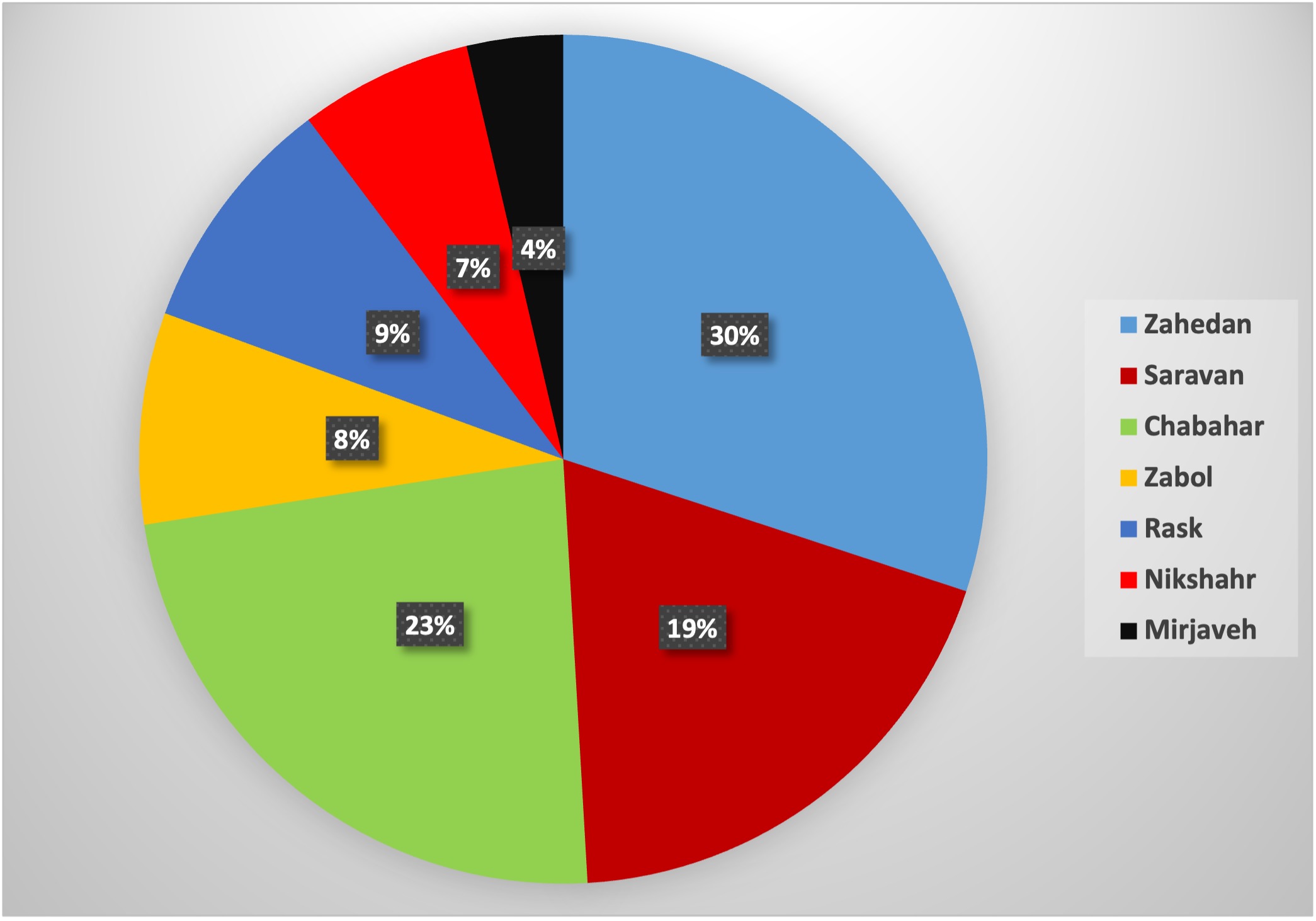
Figure 1: Jundallah’s Attack Areas (Data has been acquired from the Global Terrorism Database, Junbish.blogspot.com, and BalochNewsAgency.blogspot.com. Figure created by the author.)
However, when analyzing the types of attacks organized by Jundallah, it is clear that bombings are at the forefront. On the other hand, it is clear that the organization also uses armed attacks and, finally, kidnappings, detentions, and hostage-taking. This situation shows that Jundallah gives priority to the aim of creating a sound and a shocking effect since the type of attack it uses is mainly bomb attacks.

Figure 2: Jundallah’s Attack Types (Data has been acquired from the Global Terrorism Database, Junbish.blogspot.com, and BalochNewsAgency.blogspot.com. Figure created by the author.)
Finally, an analysis of Jundallah's attack targets shows that civilians and civilian settlements are heavily targeted. In addition, members of the Revolutionary Guards and the Basij are the second most frequently targeted. Members of other public institutions, critical infrastructure facilities, and police forces were the remaining targets. This shows that Jundallah as a whole has adopted a diversified and multi-target approach to its attack targets in order to affect all masses.

Figure 3: Jundallah’s Targets of Attack (Data has been acquired from the Global Terrorism Database, Junbish.blogspot.com, and BalochNewsAgency.blogspot.com. Figure created by the author.)
Jundallah's ideological orientation and motivation are most clearly reflected in the set of organizational discourses it uses. Between 2003 and 2010, the organization emphasized certain discourses in its propaganda publications in interaction with each other. This set of discourses revealed the organization's approach to the socio-political conjuncture, problem definitions, and demands for solutions. For example, in Jundallah's discourse set, Balochistan is identified with poverty and underdevelopment. However, discourses of Sunni Muslims and oppressed people are often used together. On the other hand, the Iranian regime interacts with discourses of discrimination and oppression. Finally, the discourses of resistance, equality and justice, and freedom were consistently used together. This set of discourses formed the framework of Jundallah's narrative that Sunni communities in Iran, especially the Sunni Baluch community, are oppressed and discriminated against by the Iranian regime and that this situation has its effects in various contexts such as poverty and underdevelopment in Sistan-Baluchestan. In the face of these alleged problems, Jundallah has positioned itself as an actor of resistance on behalf of the Sunni Baluch community and the Sunni communities living in Iran in their struggle for equality, justice, and freedom.

Figure 4: Jundallah’s Discourse Set (Figure created by the author.)
The year 2010 was a turning point for both ethno-sectarian extremism in Iran and the Jundallah organization. During this period, the leader of Jundallah, Abdulmalek Rigi, was captured by Iranian security forces and subsequently executed. This marked a serious break in the character and course of ethno-sectarian extremism in Iran. After 2010, the post-Jundallah period began, and this period brought about a serious change in the character of ethno-sectarian extremism in Iran.
Post-Jundallah Era: (2010-)
After the execution of Jundallah's leader, the first signs of the transformation of ethno-sectarian extremism in Iran appeared in the organizational context. Accordingly, after 2010, Jundallah faced disintegration and fragmentation. In this period between 2010 and 2012, Hizbul Furqan, Harakat Ansar Iran, and Jaish al Adl were established, claiming to be the representatives of Jundallah's organizational legacy[v]. Among these organizations, Hizbul Furqan and Harakat Ansar Iran decided to merge in 2013 to form Ansar al Furqan. First, by examining the ideological orientations and discourse sets of these organizations, clearer conclusions can be drawn about the character transformation of ethno-sectarian extremism in Iran in the post-Jundallah period.
In this context, it is possible to say that the Syrian crisis, which began in 2011, is a factor directly influencing the character transformation of ethno-sectarian extremism in Iran[vi]. Accordingly, Iran's siding with the Syrian regime in the Syrian crisis, as well as Iran's quest to gain influence in different regions through its affiliated Shiite militias in the process that began with this crisis, have determined the discourse sets of Ansar al Furqan and Jaish al Adl organizations. Iran's strategy has not only created negative images at the regional level but has also affected the perceptions of these organizations and thus their propaganda activities. In addition, the presence of the Daesh terrorist organization in the region since 2013 has seriously affected these organizations and shaped their approaches.
Accordingly, Ansar al Furqan and Jaish al Adl have emphasized an anti-Shia approach close to Salafism in their organizational narratives. This situation has made both anti-Shia and anti-Iranian regime among the basic codes of these organizations. Accordingly, Shiism and the Iranian regime have been identified by these organizations with Sunni hostility - paganism - Rafida - Zoroastrianism. In addition, the Iranian regime has been portrayed as a transgressor and murderer because of its position in Syria. Finally, by establishing an identity between the Baloch people and the Syrian people, the argument that both peoples are oppressed peoples who are being massacred and oppressed by the Iranian regime and that Ansar al Furqan and Jaish al Adl are waging jihad against this has been brought to the fore. The influence of the DAESH terrorist organization and the Salafist understanding of jihad can be seen in this discourse.

Figure 5: Discourse Set Ansar al Furqan and Jaish al Adl (Figure created by the author.)
In the post-Jundallah period, this analysis examines the types, regions, and targets of action of the Ansar al Furqan and Jaish al Adl organizations. The most intense areas of action are Saravan, Chabahar, and Mirjaveh regions. The two organisations primarily adopt armed attacks, followed by bomb attacks and kidnapping/hostage type actions. Finally, the two organisations have identified the Revolutionary Guards Army and the Bashij as the main targets of the attacks. The language used is clear, objective, and value-neutral, with a formal register and precise word choice. The sentence structure is simple and the logical flow of information is maintained. No changes in content have been made. However, public institutions and police forces are also targeted.

Figure 6: Attack Areas of Ansar al Furqan and Jaish al Adl (Data has been acquired from the Global Terrorism Database, Hezbulfurqan.blogspot.com, Ansariran.blog.com, Shabakeadl.org. Figure created by the author.)

Figure 7: Attack Types of Ansar al Furqan and Jaish al Adl (Data has been acquired from the Global Terrorism Database, Hezbulfurqan.blogspot.com, Ansariran.blog.com, Shabakeadl.org. Figure created by the author.)

Figure 8: Targets of Attack of Ansar al Furqan and Jaish al Adl (Data has been acquired from the Global Terrorism Database, Hezbulfurqan.blogspot.com, Ansariran.blog.com, Shabakeadl.org. Figure created by the author.)
Future Projections
The future of ethno-sectarian extremism in Iran is influenced by regional developments, crises, and ideological currents. The impact of these factors was observed in the cases of BAM and Jundallah, where the developments in Afghanistan and the emerging ideological currents had a clear effect on the groups. However, it has been determined that the ideological orientations of Ansar al Furqan and Jaish al Adl organizations have been influenced by DAESH and the Salafi-jihad understanding in the post-Jundallah period.
New developments and crises in the region will likely continue to have a decisive impact. For instance, the emergence of the Taliban administration in Afghanistan and the increased activity of the DAESH-Horasan organization are indicative of this regional influence. These developments may have a short-term impact on Ansar al Furqan and Jaish al Adl. It is possible that Afghanistan will become more involved in the issue of ethno-sectarian extremism in Iran and that ethno-sectarian organizations may integrate with the DAESH-Horasan structure. However, it is important to note that poverty and development issues have intensified in Sistan-Baluchistan, and there is a growing perception of discrimination against the Sunni identity in Iran. In the last four years, there have been several popular uprisings and mass movements in Sistan-Baluchistan, indicating the dynamic socio-political conditions of the region and creating a favorable ground for extremism to flourish.
However, when comparing the two organizations, it appears that Jaish al Adl will be more active than Ansar al Furqan. The actions of both groups are expected to target the Iranian army and security forces in regions located on the Iran-Pakistan and Iran-Afghanistan border lines. These actions will mostly involve armed attacks. In this context, it could be argued that Iran may face more problems and tensions with Pakistan and Afghanistan in the pursuit of border security.
Endnotes
[i] Dashti, N. (2017). The Baloch Conflict with Iran and Pakistan: Aspects of a National Liberation
Struggle. Trafford Publishing.
[ii] Zambelis, Chris.(2006). Violence and Rebellion in Iranian Balochistan, Jamestown Terrorism Monitor, https://jamestown.org/program/violence-and-rebellion-in-iranian-balochistan/
[iii] Hoshang, N. (2015). Sunni Militants in Iran: Activities, İdeological Sources and Political Strategies.
International Research Journal of Social Sciences, 4(3), 79-87.
[iv] Dudoignon, S.A.(2017). The Baluch, Sunnism and the State in Iran: From Tribal to Global. Oxford University Press.
[v] Zambelis, Chris. (2019). A New Phase of Resistance and Insurgency in Iranian Baluchistan. Combating Terrorism Center (CTC), https://ctc.usma.edu/a-new-phase-of-resistance-and-insurgency-in-iranian-baluchistan/
[vi] Cappuccino, Nicholas. (2017). Baluch Insurgents in Iran, https://iranprimer.usip.org/blog/2017/apr/05/baluch-insurgents-iran