
Archaeological excavation of ancient cities of Myrina and Gryneion will be given start in the year 2021 under the leadership of İzmir Archaeological Museum and Scientific Consultancy of AYBU Faculty Member of Faculty of Humanities and Social Sciences Department of Art History Archaeologist Assoc. Dr. Yusuf ALBAYRAK. Archaeological excavation and restoration studies of ancient cities of Myrina and Gryneion will be held as excavation that will take 12 months on behalf of AYBU and with the acceptance of Presidency in the year 2022.
Ancient City of Myrina:
Myrina is located in the north of Aliağa District of İzmir; along with the coast of Çandarlı Gulf and nearby Güzelhisar Stream.
Strabon states that Myrina is a city with a harbour to Elaitikos Bay. Strabon, who claims that Ephesos, Smyrna, Kyme and Myrina had been founded by the Amazons and were named by the founder of the city, refers to the achievement and speed in naming.
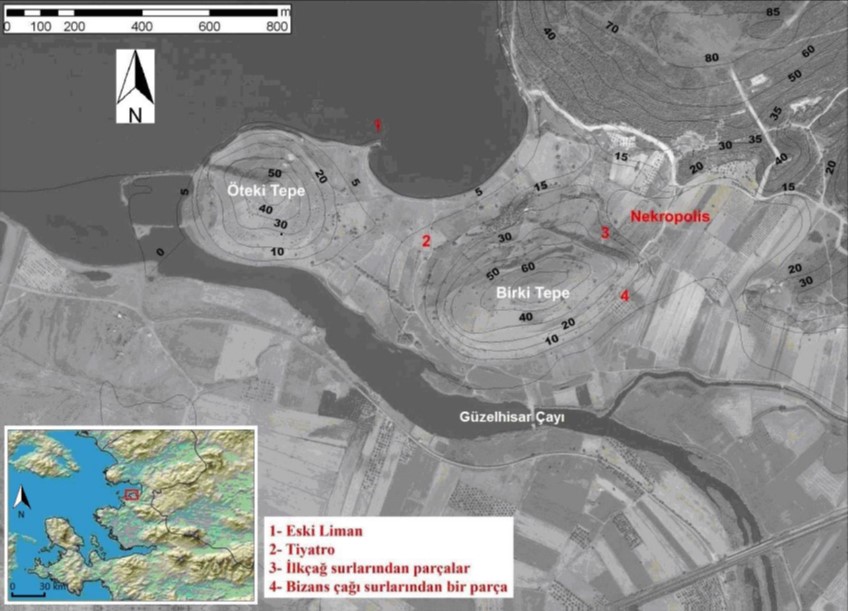
Ancient City of Myrina were located on two hills called Beriki Hill (Değirmen Hill) and Öteki Hill (Kalabasar Hill). The former names of these hills are Epano Hill and Kato Hill. Kalabasar Valley that has a coast to the city is located on the area between those two hills. Kalabasar Harbor is located on the north of this valley. Beriki Hill is an acropolis and its walls are ebroided with polygonal stones.
Myrina, that is the second largest city after Kyme is located in South Aiolis region, is located on 55km northwest of İzmir. It is located on the coast of Elaitikos Gulf and nearby Little Titnaios Stream. It is is one of the first members of Attika Delos sea union. After the great earthquake of 17 ad, the city was reformed by Emperor Tiberus and named as Sebastopolis for a short time. The city, which also experienced the earthquake that took place on 106, has been a bishopric centre on 4-5 ad within the body of Ephesus Metropolis.
Like many ancient cities in Western Anatolia, Myrina had been effected by earthquakes. Like other cities of Aiolis, the city was effected badly by the earthquake that took place on 17ad and reformed by Emperor Tiberus. The city, which also experienced the earthquake that took place on 106, was reformed, but it lost its importance on the spread of Christianity and then disappeared.
M. E. Baltazzi, the person who did the first research on the city in the year 1874, came up with almost 5.000 terra-cotta figures. Members of French Athina also carried out excavation in the region.
Sayce, who did a research on Beriki Hill, believes that the region is a prehistoric residence. He also states that this region used to be used as a graveyard and the graves probably belongs to the wealthy families of Myrina. Sayce, who believes that Ancient Greece destroyed the city of the residents of Aioil and captured the territory, refers to the fact that the huge walls without any trace of metal had been built during Hellenistic Age and thus have prehistoric traces. He claims that the city was abandoned after being destroyed by the attacks, but reformed in an area that is 10km away nearby the stream and named after the former residence.
Archaeological excavation of Myrina was carried out in 1970s and just like experienced in the former researches, many terra-cotta sculptures that belong to Hellenistic Age were founded. Archaeological excavation was carried out on Ancient Cities of Myrina and Gryneion from the year 2011 to 2013 by Nurettin ÖZTÜRK. Archaeological excavation was carried out on Ancient Cities of Myrina and Gryneion from the year 2015 to 2017 by a science team under the leadership of Assoc. Dr. Murat Çekilmez. Ancient Cities of Myrina and Gryneion
Architectural Structures of the City:
Harbour: Harbour is the only structure that has managed to reach today with its material. It is located on the northeast of Öteki Hill.
Water Wall: A waterwall has been discovered on the west of Ancient City of Myrina. Myrina
Theatre: Theathre of Myrina has been discovered on the northwest of Beriki Hilll. The remnants of the theathre are not specific today.
Agora: The agora of Myrina has been located on the northeast of the city.
Necropolis: The graves of Myrina Necropolis that is located on northeast of the city are mostly well-preserved.
Gryneion:
Ancient City of Gryneion is located on the area between Aliağa and Çandarlı; 1 km south of Yeni Şakrak Village.
Strabom mentions Gryneion which belongs to the city of Myrina as well as the existence of Appollon oracle place.
Poplar geographer and traveller Pausanias, who refers to the shields, states that linen shields that are dedicated to the temples can be seen in Gryneion. He says that there is a holly wood dedicated to Apollon in Gryneion and adds that the appearance of the trees and woods which is the best wood dedicated to Apollon in the area is nice.
In the year 1992, surface exploration and a rescue excavation were carried out on the area Gryneion is located under the leadership of the director of İzmir Archaeology Museum Dr. Turhann Özhan.
There is no mentioning of any structure except for The Temple of Apollo, harbour and the graves in necropolis in either surface exploration or ancient resources. Considering Strabon’s statements, it is possible to say that Gryneion is a holly place and may be within the body of Myrina.
Regarding their geographical location, Myrina and Gryneion are the one of the most well-known ancient cities of Aegean Region considering their political history. There are fortification walls and remnants that belong to agora and theatre that came into existence with illegal excavations in Myrina. Civil structures are either not determined yet or disappeared in different times. Rescue excavation was carried out only necropolis area. The city attracts attention thanks to being an important harbour city of Aioil region. According to ancient resources, the location of Holly place of Apollo in Gryneion also has an effect on the significance of the city.
Thanks to a scrutinized study in these cities, these cities will have a quality to have the traces of the past and the present within ten years. Although there is a limited archaeological information gathered via surface exploration, it is evident that any kind of research will provide new information. Exact information concerning these structures may be reached after excavation of theatre agora and wall areas. In addition to this, thanks to the excavation on necropolis area, information on the burial tradition of the city and culture of the city will be reached.